
Arrest Records give instant insight into Kern County arrest records, Kern County CA arrest records, and related public data, letting anyone pinpoint an arrest history quickly. When you type a name, date, or location into a reliable lookup, the system pulls the arrest record search by name, by date, and by arresting agency from the official Kern County arrest database. This fast Kern County CA lookup connects you to arrest information such as arrest case numbers, booking details, and the agency that made the arrest, all without the usual paperwork delays. Users often need to verify a person’s arrest record number or check the status of an arrest report, and the 24/7 support ensures answers at any hour. By focusing on arrest records lookup, you can confirm whether a record is active, pending, or closed, and you’ll see the exact arrest date, location, and any associated charges, helping you make informed decisions for hiring, tenancy, or personal safety.
Arrest Records also serve as a gateway to deeper research, offering arrest history, arrest information, and arrest records online that are publicly accessible. Whether you search by arresting agency, by case or report number, or by specific location within Kern County, the database delivers precise results for each query. This resource supports comprehensive arrest record search by date, by name, and by county, ensuring you can find arrest records by county or even narrow results to a particular street address. The platform’s robust search capabilities let you explore arrest records search by location, arrest records search by arresting agency, and even arrest records search by date range, giving you full control over the information you need.
How to Search Arrest Records
Searching arrest records in Kern County CA gives you a direct path to public arrest data held by local law enforcement. You can look up arrest records by name by reviewing official inmate search case files, arrest date, location, arresting agency, or case number through official channels. The Kern County Sheriff’s Office maintains the primary database that powers these lookups, and the system updates regularly to reflect new bookings, releases, and warrant arrests. You do not need to create an account or pay a fee to perform a basic arrest record search on the public portal.
Official Search Portal: https://www.kernsheriff.org
Steps to Search
- Visit the Kern County Sheriff’s Office website at https://www.kernsheriff.org to access the public arrest records search.
- Select your search method from the available options, such as name, date, or case number.
- Enter the required details into the search fields and confirm the information is correct.
- Review the list of matching arrest records and click the entry that matches your query.
- View the full arrest details, including charges, booking information, and case status.
Search by Name
A name-based search is the most common way to find arrest records in Kern County. You enter the person’s full legal name, and the system pulls matching entries across recent bookings and historical arrests. The portal shows results that match the exact spelling and similar name variants, so you should confirm the match by checking the date of birth or arrest date when available. If the name is common, narrow your search by adding a first name, middle name, or known alias to reduce duplicate listings.
Search by Arrest Date
Searching by arrest date lets you find records tied to a specific day or short timeframe. You select a calendar date within the portal, and the database displays every booking logged on that date by Kern County law enforcement. This method works well when you know the date someone was taken into custody but lack their full name. For older records, you may need to extend the search range since some historical arrest logs have different retention rules.
Search by Arrest Location
An arrest location search filters records by where the arrest took place, such as a city, street, or district within Kern County. You type the location details into the search field, and the system returns arrests that occurred in that area. This lookup helps when you want to review arrest activity in a neighborhood, near a specific address, or within a jurisdiction like Bakersfield, Ridgecrest, or Delano. Pairing a location with a date range often produces the most accurate results.
Search by Arresting Agency
You can also search arrest records by the agency that made the arrest, such as the Kern County Sheriff’s Office, Bakersfield Police Department, or California Highway Patrol. The portal sorts the results by agency, which makes it easier to follow arrests handled by a specific department. Agency-based searches are useful for journalists, employers, and legal professionals tracking cases tied to certain enforcement units. Each agency report number links directly to the arrest record in question.
Search by Case or Report Number
If you already have a case number or arrest report number, the fastest lookup is a direct number search. You enter the number into the appropriate field, and the portal retrieves the exact arrest record tied to that identifier. This method removes confusion from common names and gives you a clean result in seconds. Court paperwork, attorney correspondence, and police blotter entries often include these numbers for one-time reference.
Information Needed for an Arrest Records Search
Before you start a search, gather as many identifying details as possible to improve accuracy. Useful data points include the person’s full name, date of birth, arrest date, arrest location, arresting agency, booking number, or case number. The more fields you fill in, the narrower your results become, which reduces time spent scrolling through unrelated entries. Even partial information, such as a first name and a city, can produce a usable match when combined with other filters.
Arrest Record Information
An arrest record in Kern County CA presents a structured snapshot of a single arrest event. Each record ties a named individual to a specific date, location, and enforcement action, giving you a complete view of what happened. You can use these records for personal knowledge, due diligence, or legal preparation. Below are the core data fields you will see in a standard Kern County arrest record.
Person’s Name
The person’s name field shows the full legal name on file at the time of arrest, which may include aliases or prior names. Kern County records often list a primary name followed by known aliases when applicable. This field anchors every search by name and serves as the key reference point across all related records. Always confirm the spelling matches the person you are researching before drawing conclusions from the other fields.
Arrest Date and Time
The arrest date and time stamp marks the exact moment law enforcement took the individual into custody. This field is critical for matching arrests with news reports, court filings, and booking logs. Kern County records typically log the time to the minute, which supports precise verification. If a record shows only a date, the time may not have been captured due to data entry limits on older cases.
Arrest Location
The arrest location field lists where the arrest occurred, down to the street address or nearest cross street when available. Common entries include cities like Bakersfield, Tehachapi, or Wasco, along with rural unincorporated areas of Kern County. Some records use general area descriptions when a precise address is not on file. The location helps connect an arrest to patrol zones, investigative reports, and geographic crime data.
Arresting Agency
The arresting agency identifies which law enforcement body conducted the arrest. Kern County Sheriff’s Office handles most county-level arrests, while city police departments cover Bakersfield, Ridgecrest, and other municipal areas. State agencies such as the California Highway Patrol also appear for arrests made on state highways and interstates. The agency field links directly to the agency’s own report number for cross-referencing.
Arrest Number
An arrest number is a unique tracking ID assigned by the arresting agency at the time of booking. This number follows the arrest through booking, processing, and any transfer between facilities. You can use an arrest number to pull the complete file from the agency that issued it. Agencies keep these numbers stable even when charges change or cases move to different courts.
Case Number
The case number connects the arrest to the court case that follows. Kern County courts assign case numbers after the District Attorney files formal charges, which may differ from the arrest number. You can use a case number to check court calendars, retrieve dispositions, and request certified court records. Case numbers follow the case through every hearing until final resolution.
Arrest Status
Arrest status shows where the case currently sits in the legal pipeline. Status values include active, pending court action, released, transferred, or closed. This field updates as the case moves through arraignment, hearings, plea deals, and sentencing. Always check the arrest status before assuming any outcome based on older data.
Available Arrest Details
Beyond the core fields, Kern County arrest records present extra details when available. These details may include the arresting officer, booking facility, custody status, and warrant references. Some entries also list multiple charges, updated charge descriptions, and any linked mugshots. The richness of detail depends on the arrest type and how long ago the record was created.
Arrest Details
Arrest details expand on the basic record by adding context about why the arrest happened. These fields cover the reason for arrest, the charges filed, the offense description, and the circumstances surrounding the event. You can use these details to understand the nature of the arrest without needing separate court records. Kern County arrest records organize this information in a clear, consistent format for quick reading.
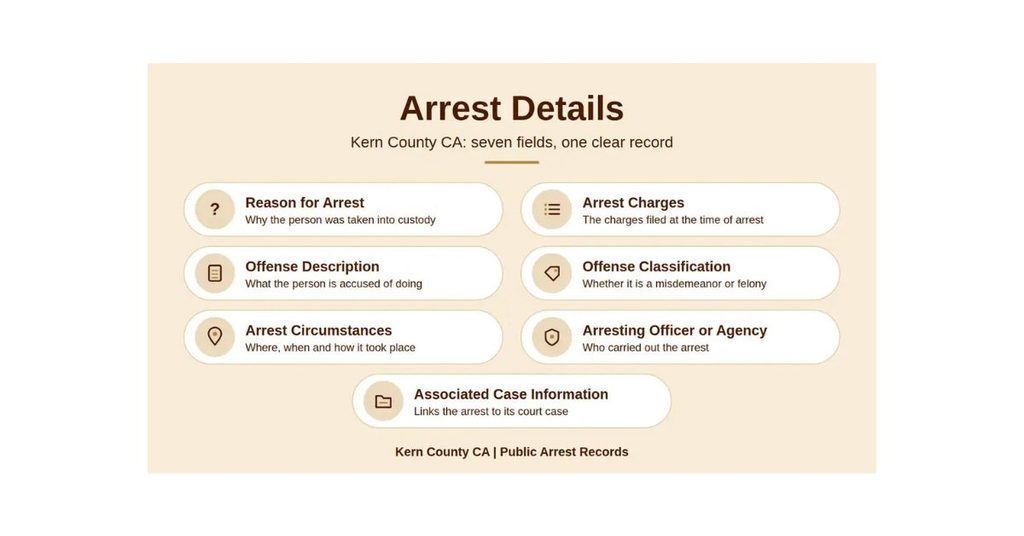
Reason for Arrest
The reason for arrest explains the immediate cause that led law enforcement to take the individual into custody. Common reasons include suspicious activity, traffic violations, outstanding warrants, and reported crimes. This field gives you the basic narrative for the arrest event. It often differs from the formal charges, which come later in court filings.
Arrest Charges
Arrest charges list the specific criminal allegations tied to the arrest at the time of booking. These charges may include misdemeanors, felonies, infractions, or a combination. The Kern County system groups charges by severity and statute reference. Each charge has a corresponding number for easy cross-reference with court documents.
Offense Description
The offense description gives a plain-language summary of each charge listed in the arrest record. For example, a charge under California Penal Code 211 might show as “robbery.” This field helps non-legal users understand the nature of the allegation. Offense descriptions follow standard language set by the arresting agency and court system.
Offense Classification
Offense classification groups each charge by legal category. Common categories in California include misdemeanor, felony, and infraction. Kern County records also note whether a charge is a wobbler, meaning prosecutors can file it as either a misdemeanor or felony. Classification affects bail, sentencing, and how the case moves forward in court.
Arrest Circumstances
Arrest circumstances describe what happened during the arrest event itself, such as whether the arrest followed a pursuit, a traffic stop, or a warrant service. This field also notes whether force was used, whether the suspect resisted, and whether anyone was injured. Circumstance data helps clarify how the arrest unfolded and supports review of police conduct. The level of detail varies based on the agency’s report standards.
Arresting Officer or Agency
The arresting officer or agency field lists the specific officer who led the arrest, along with badge or unit numbers when available. Kern County records include this data for transparency and accountability. You can use the officer information to request body camera footage, internal reports, or civilian complaint histories. Officer names appear only when public disclosure rules allow.
Associated Case Information
Associated case information ties the arrest to other legal events, such as court cases, probation holds, or parole violations. Each link shows the case number, court, and current status. Kern County arrest records often reference prior arrests to build a fuller arrest history. This context helps when assessing risk for employment, housing, or personal safety decisions.
Charges and Offenses
Arrest charges and offenses form the legal core of every Kern County arrest record. Each charge carries its own statute, classification, and description that determine how the case moves through the system. You can review these charges to understand the seriousness of the arrest and its likely legal consequences. The charge list often changes between arrest and court filing, so always check the most current version.
Misdemeanor Charges
Misdemeanor charges cover less serious offenses punishable by up to one year in county jail and fines. Common Kern County misdemeanors include petty theft, simple assault, public intoxication, and minor drug possession. Misdemeanors appear on arrest records with the statute code and a short description. These charges often resolve through plea deals, diversion programs, or court-ordered probation.
Felony Charges
Felony charges involve serious offenses punishable by more than one year in state prison. Examples include robbery, burglary, major drug sales, and violent assaults. Kern County arrest records flag felony charges clearly, often with a higher severity marker. Felony cases usually move to Superior Court for formal prosecution.
Multiple Charges
Many Kern County arrests involve more than one charge from a single event. For example, a burglary arrest may also include charges for possession of burglary tools and resisting arrest. Each charge appears as a separate line item with its own number, description, and classification. Reviewing all charges gives you a fuller picture of the arrest scope.
Charge Numbers
Charge numbers assign a unique identifier to each charge within an arrest record. These numbers stay fixed through court filings, making cross-referencing simple across documents. Kern County court systems use the same charge numbers when listing counts on indictments and complaints. You can match charge numbers between the arrest record and court papers for accurate tracking.
Charge Descriptions
Charge descriptions provide a plain explanation of each charge, written in everyday language. A charge coded as “PC 459” may show the description “burglary.” These descriptions help non-lawyers understand what the charge means in real terms. Kern County uses standardized language drawn from court and law enforcement glossaries.
Original and Updated Charges
Arrest records often list both the original charges at booking and any updated charges filed later by the District Attorney. Prosecutors may add, drop, or modify charges before the arraignment. The record shows the timeline of those changes so you can track the case as it evolves. Reviewing updated versions prevents relying on outdated charge information.
Pending Charges
Pending charges are allegations that have not yet been filed formally with the court. Kern County arrest records mark pending charges clearly so users know the case is still under review. These charges may change before the first court appearance or disappear entirely if prosecutors decline to file. Always verify the status before drawing any conclusions from pending charges.
Date and Location
Filtering arrest records by date and location narrows your results and improves accuracy. Kern County’s public portal supports date-based, range-based, city-level, street-level, and district-level searches. You can combine these filters with a name search for the most precise lookup. Below are the main date and location tools available in the public arrest record system.
Search by Arrest Date
An arrest date search returns every booking logged on a single calendar day. You select a date from the search field, and the portal lists all arrests processed that day by Kern County law enforcement. This tool helps when you know the arrest day but not the person’s name. Pair the date with a city filter to focus on a specific area within the county.
Search by Date Range
A date range search covers a span of days, weeks, or months. You enter a start date and end date, and the system returns all arrests logged within that window. Date ranges help when investigating a series of related incidents or when tracking arrest activity over time. Kern County’s portal allows ranges of up to several months in a single query.
Search by City
A city search limits results to arrests that occurred within a specific municipality in Kern County. Cities such as Bakersfield, Delano, Ridgecrest, Tehachapi, and Shafter each have their own arrest logs. Use this filter to focus on a known location. Combine the city with a date range to refine results further.
Search by Street Address
Street address searches pull arrests tied to a specific address or intersection. You type the address or cross streets into the search field, and the portal returns matching entries. This tool helps confirm incidents at a known location, such as a reported crime scene. Address-based results depend on accurate geocoding in the arrest record.
Search by Arrest Area or District
Area or district searches sort arrests by patrol boundaries set by the Kern County Sheriff’s Office. Each district covers a defined portion of the county, such as the North, East, or South Patrol areas. District searches help when reviewing enforcement patterns in specific zones. This filter pairs naturally with date ranges for trend analysis.
Historical Arrest Records
Historical arrest records cover older bookings that may sit in archived databases. Kern County retains arrest records for years, but older entries may have limited detail. You can search historical records through the public portal or by contacting the Records Bureau directly. Expect some delays when requesting archived documents due to manual retrieval processes.
Arresting Agency Records
Arresting agency records show which law enforcement body handled each arrest in Kern County. Each agency maintains its own booking logs, report numbers, and custody records. You can search these agency records directly or through the unified Kern County portal. The agency listed on an arrest record determines which office holds the primary source documents.
Sheriff’s Office Arrest Records
The Kern County Sheriff’s Office handles most arrests in unincorporated areas and contract cities. Sheriff’s Office records cover bookings at the Central Receiving Facility in Bakersfield and substations in outlying communities. You can search Sheriff’s Office arrests through the countywide portal or request records directly from the Sheriff’s Records Bureau. Each entry includes a Sheriff’s report number for follow-up requests.
Police Department Arrest Records
City police departments, including the Bakersfield Police Department, maintain their own arrest logs for arrests within city limits. Police Department records cover municipal enforcement actions, citations, and bookings at city jails. You can search these records through each department’s public portal or the unified Kern County search. Each department uses its own report number system.
County Law Enforcement Records
County law enforcement records cover agencies that operate at the county level, such as the Kern County Sheriff’s Office, Kern County Probation Department, and District Attorney’s Office investigators. These agencies share booking facilities and report to the county records system. County records often include arrests tied to probation violations, parole holds, and court orders.
State Law Enforcement Records
State law enforcement agencies, including the California Highway Patrol, California Department of Corrections and Rehabilitation, and California State Parole, also book suspects into Kern County custody. State records appear in the Kern County portal when the arrest took place in the county. These records often involve highway stops, parole violations, and interstate crime cases.
Multi-Agency Arrest Records
Multi-agency arrests happen when more than one law enforcement body participates in a single arrest. For example, the Sheriff’s Office and the FBI may jointly arrest a suspect in a federal case. Kern County arrest records note each agency involved in these joint operations. Multi-agency entries may link to multiple report numbers across jurisdictions.
Agency Report Numbers
Every agency assigns its own report number to each arrest. The report number ties the arrest to incident reports, supplemental narratives, and investigative files. You can use the agency report number to request full records from the originating agency. Report numbers remain active for the life of the case and through any appeals.
Records and Booking Information
Booking information adds detail to an arrest record by documenting what happened at the jail or holding facility. The booking process includes fingerprinting, photographing, medical screening, and assigning a custody status. Kern County booking data ties directly to the arrest record through the booking number. Reviewing booking information helps clarify what happened once the arrest reached the facility.
Arrest and Booking
An arrest happens when law enforcement takes a person into custody, while booking happens after the person arrives at the jail. Booking creates the official jail record and assigns the booking number. Kern County arrest records mark the distinction between the two events with separate timestamps. Understanding the difference helps you read records accurately.
Booking Number
The booking number is a unique identifier assigned when the suspect enters the jail. Kern County uses booking numbers to track each individual through intake, housing, and release. You can use a booking number to look up current inmate status. The booking number often differs from the arrest number, even when tied to the same event.
Booking Date
The booking date shows when the suspect was officially processed into custody. This date may differ from the arrest date when arrests happen late at night or during weekends. Kern County books suspects 24 hours a day, seven days a week. The booking date anchors the timeline for all subsequent custody events.
Booking Facility
The booking facility is the jail or holding center where the suspect was processed. Kern County’s main booking facility is the Central Receiving Facility in Bakersfield. Some arrests may route to city jail facilities before county booking. The facility field helps clarify jurisdiction and custody authority.
Booking Charges
Booking charges list the charges that led to detention at the time of intake. These charges may differ from later court filings if prosecutors adjust the allegations. Kern County booking records show the initial charges that determined bail and custody status. Always check for updates once the case reaches the court.
Custody Status
Custody status shows whether the person is still in jail, released on bail, transferred, or on supervised release. Kern County updates custody status regularly as the case moves forward. The status field is one of the most useful data points for confirming current location. Check this field before relying on older arrest data.
Release or Transfer Information
Release or transfer information documents how and when the person left custody. Common release types include bail release, own recognizance release, cite and release, and transfer to another facility. Kern County records log the release date, time, and responsible officer. Transfer information may note the receiving agency or institution.
Arrest Records and Warrants
Warrants play a major role in many Kern County arrests. A warrant gives law enforcement legal authority to arrest a person suspected of a crime or to enforce a court order. Kern County arrest records show whether an arrest was warrant-based and link to warrant details when available. Understanding warrant information helps you read arrest records more accurately.
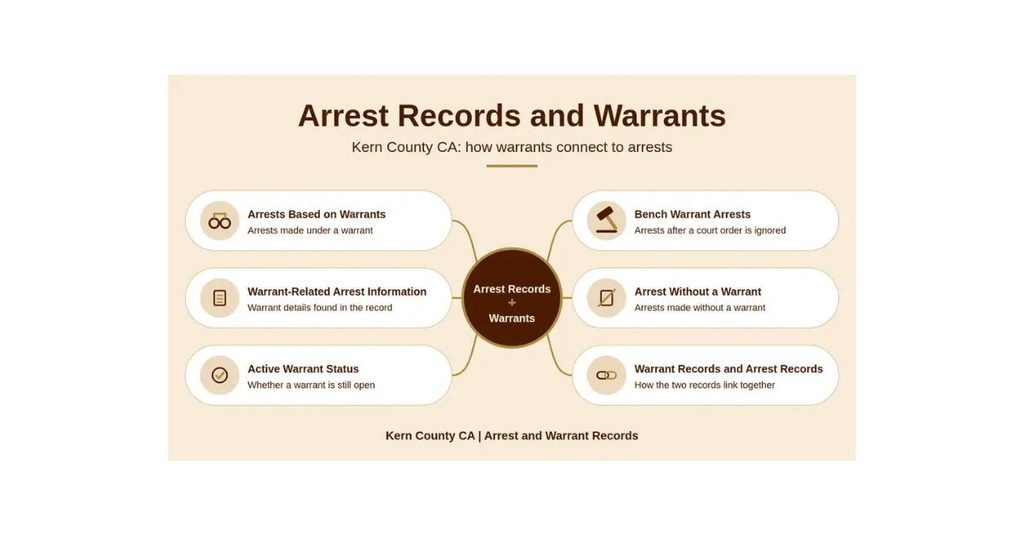
Arrests Based on Warrants
Many arrests in Kern County happen when officers execute an arrest warrant. Warrant-based arrests follow a separate intake process and may show different charge sets than the original warrant allegations. Arrest records note the warrant reference so users can pull the underlying warrant details. Warrant arrests often lead to a court appearance within a short timeframe.
Warrant-Related Arrest Information
Warrant-related arrest information includes the warrant number, issuing court, and offense tied to the warrant. This data ties the arrest back to the original case or new allegation. Kern County records show whether the warrant was active, recalled, or cleared by arrest. Warrant details help verify the legal basis for the arrest.
Active Warrant Status
An active warrant means law enforcement has current authority to arrest the named individual. Kern County arrest records may show an active warrant flag at the time of arrest. This field is useful for employers, landlords, and individuals verifying someone else’s status. Active warrant status updates immediately upon arrest.
Bench Warrant Arrests
Bench warrants are issued by a judge when a person fails to appear in court or violates a court order. Kern County arrest records identify these arrests separately from criminal warrants. Bench warrant arrests often lead to quick court hearings to resolve the underlying failure to appear. The record notes the original case and missed court date.
Arrest Without a Warrant
Some arrests happen without a warrant when officers observe a crime in progress or have probable cause. Kern County arrest records note warrantless arrests and the legal basis cited by the officer. These arrests often lead to faster arraignments due to fresh probable cause findings. The record explains the circumstances leading to the warrantless action.
Warrant Records and Arrest Records
Warrant records and arrest records serve different functions. Warrant records show the legal authority to take someone into custody, while arrest records show what happened once the person was in custody. Both appear in the Kern County system and often link to each other. Review both record types for a complete picture of a warrant-based arrest.
Court Cases
Court cases often follow an arrest and add important context to what the arrest record alone shows. Kern County arrest records link to court cases through case numbers and filing details. Court records cover arraignments, hearings, plea deals, verdicts, and sentencing. You can use both record types together to follow a case from arrest through resolution.
Case Number
The case number connects an arrest to a specific court filing. Kern County courts assign case numbers after the District Attorney files formal charges. You can use a case number to look up court calendars and case status. Case numbers appear on both arrest records and court records for easy matching.
Court Case Information
Court case information includes the court name, department, judge, and next hearing date. Kern County Superior Court handles felony cases, while the Kern County Superior Court’s misdemeanor divisions handle lesser charges. The arrest record may link directly to the court docket when available. Court case information updates as the case progresses.
Filing of Charges
The filing of charges marks the official start of the court case. Prosecutors file charges after reviewing the arrest report and evidence. Kern County arrest records show when charges were filed and which counts the District Attorney pursued. This step distinguishes between arrest allegations and formal criminal charges.
Court Hearings
Court hearings cover arraignment, pretrial motions, evidence hearings, plea hearings, and trial. Kern County arrest records link to upcoming hearing dates so users can follow the case. Hearing information helps employers, attorneys, and family members track case progress. Always confirm hearing dates directly with the court calendar before attending.
Case Disposition
The case disposition shows the final outcome of the court case. Dispositions include guilty plea, not guilty verdict, dismissal, acquittal, diversion, and sentence completion. Kern County arrest records display the disposition once the court enters a final ruling. Reviewing the disposition is essential for understanding the full legal outcome.
Arrest Record and Court Record
An arrest record documents the arrest event, while a court record documents the legal case that follows. Kern County maintains both systems, and they share key identifiers like the case number. The arrest record alone does not show guilt or innocence. You must review the court record for the final outcome.
Arrest Does Not Establish Guilt
An arrest is not proof of guilt. Under California law, every person arrested is presumed innocent until proven guilty in court. Kern County arrest records clearly note this legal standard. Employers, landlords, and the media should weigh this fact when reviewing arrest data. Always pair arrest records with court dispositions for a fair view.
Arrest Record Status
Arrest record status tracks where a case currently sits within the legal pipeline. Status fields change as the case moves from booking through court hearings and final resolution. Kern County updates arrest record status regularly to reflect new information. Knowing the status helps you understand whether a record is active, pending, or closed.
Active Arrest Records
Active arrest records show cases still in process with no final disposition. These cases may be at the arraignment stage, pretrial phase, or trial stage. Kern County marks active records clearly so users know the case is ongoing. Active cases may change as new hearings occur or pleas are entered.
Pending Cases
Pending cases sit between arrest and the first court filing. Kern County arrest records mark pending cases when prosecutors have not yet filed formal charges. Pending status may last days or weeks depending on the case complexity. Once charges are filed, the case moves to active status.
Closed Arrest Records
Closed arrest records show cases that have reached a final resolution. Resolutions include dismissal, acquittal, conviction, sentence completion, or diversion completion. Kern County closes arrest records once the court enters a final disposition. Closed records remain accessible but no longer change status.
Dismissed Charges
Dismissed charges occur when the court or prosecutor drops the allegations. Kern County arrest records update to show dismissed charges and the reason for dismissal. Common reasons include lack of evidence, witness issues, or procedural errors. Dismissed charges still appear on the record but carry a dismissed flag.
Charges Reduced or Changed
Prosecutors may reduce or modify charges as the case develops. Kern County arrest records show both by reviewing official bankruptcy portal, the original and updated charges for transparency. Charge reductions often follow plea negotiations or evidence reviews. Review the updated charges before drawing conclusions about the arrest.
Case Disposition
Case disposition shows the final legal outcome of the case, such as conviction, acquittal, or dismissal. Kern County arrest records display the disposition once entered by the court. Disposition data is the most reliable indicator of case resolution. Always check the disposition field before relying on arrest data.
Record Updates
Record updates happen whenever new information enters the system, such as a new court date, charge change, or release event. Kern County updates records based on agency reports and court filings. Updates may take a few days to appear in the public portal. Always check the record date when reviewing arrest data.
Records and Mugshots
Mugshots are booking photographs taken during the intake process at a jail facility. Kern County arrest records may include a mugshot when one was taken at booking. Not every record has a mugshot, and access rules vary based on the case type. Below is what you should know about arrest records and booking photos.
Booking Photograph Availability
Booking photograph availability depends on the facility’s intake procedures and the case’s status. Kern County takes mugshots during booking for most arrests. Photographs may not appear immediately in the public portal due to processing delays. Some records have no photograph due to data limits or restricted access rules.
Arrest Record and Mugshot Differences
An arrest record documents the arrest event, while a mugshot is a single photograph from booking. The two data points tie to the same booking but serve different purposes. Kern County shows the mugshot alongside the arrest record when available. Always review both pieces together for full context.
Matching a Mugshot to an Arrest Record
Matching a mugshot to an arrest record requires comparing the booking date, booking number, and personal identifiers. Kern County links the photograph directly to the arrest record in the portal. Cross-referencing with name and date of birth helps confirm the match. The portal displays the mugshot within the arrest record view.
Missing Booking Photographs
Some arrest records have missing booking photographs due to technical issues, retention policies, or restricted access. Older records may not include mugshots if they were archived or purged. Kern County notes the absence of a photo on the arrest record page. You can request a photograph directly from the booking facility when needed.
Photograph Access Restrictions
Photograph access may be restricted by court order, privacy rules, or juvenile protections. Kern County removes mugshots from public view when legal restrictions apply. Restricted photos may still exist internally but stay hidden from public searches. Always check the access status before assuming a photo is missing.
Public Access
Arrest records in California are generally public under the California Public Records Act and the state’s Public Records Law. Kern County follows these rules while protecting certain sensitive information. You can access most arrest records online, by request, or in person. Some data, however, stays confidential due to legal protections.
Public Arrest Information
Public arrest information includes the person’s name, arrest date, arrest location, arresting agency, and case number. Kern County publishes this data through the public portal and records requests. Public data supports transparency in law enforcement. Some entries, however, exclude sensitive fields under state law.
Online Arrest Records
Online arrest records are available through the Kern County Sheriff’s Office public portal. The portal shows current bookings, recent arrests, and historical entries. You can search by name, date, location, or agency. Online records update regularly based on new bookings and court filings.
Records Available by Request
Records available by request include full arrest reports, booking photos, and supplemental documents. You can submit a request online, by mail, or in person to the Kern County Sheriff’s Records Bureau. Requested records may include redactions to protect sensitive information. Processing times vary based on the request type and workload.
Redacted Arrest Information
Redacted arrest information removes sensitive fields such as Social Security numbers, driver’s license numbers, and certain personal identifiers. Kern County applies redactions before releasing records to the public. Redacted records still meet transparency rules while protecting privacy. Review the redaction notice for details on what was removed.
Confidential Information
Confidential information stays hidden due to legal protections. Examples include juvenile records, sealed cases, and ongoing investigation details. Kern County removes these fields from public records. Confidential data may still be accessible through a court order or formal legal request.
Juvenile Arrest Records
Juvenile arrest records are not part of the standard public arrest database. California law seals juvenile records to protect minors. Kern County limits access to juvenile records to the court, the minor’s parents, and authorized attorneys. Public portal searches will not return juvenile arrest entries.
Active Investigation Restrictions
Active investigation restrictions limit access to arrest records tied to ongoing cases. Kern County may withhold certain details while an investigation is active. Restrictions lift once the investigation closes or the court authorizes release. Restricted records may still be available through formal legal channels.
Obtaining Arrest Records
You can obtain Kern County arrest records through online requests, in-person visits, or mail requests. Each method has its own steps, fees, and processing times. Choose the method that fits your timeline and document needs. Below is a breakdown of each request type and what you need to know before submitting.
Online Records Requests
Online records requests are the fastest way to obtain arrest records. You submit a request through the Kern County Sheriff’s Office public portal and receive the response electronically. Online requests work well for basic arrest data and recent booking records. Expect standard processing times of a few business days for most online requests.
In-Person Requests
In-person requests let you visit the Records Bureau at the Kern County Sheriff’s Office. The Records Bureau staff can help you locate files, review basic documents, and accept payment for copies. In-person visits work well when you need records immediately or want to clarify details with staff. Bring valid ID and any reference numbers you have.
Mail Requests
Mail requests let you submit a written request by postal mail. Include the person’s name, date of birth, arrest date, and case number when available. Mail requests work well for formal records used in court or background checks. Processing times for mail requests are longer than online or in-person options.
Required Request Information
Required request information helps staff locate the right record quickly. Common fields include the person’s full name, date of birth, arrest date, location, arresting agency, booking number, and case number. The more details you provide, the faster staff can process the request. Incomplete requests may lead to delays or returned applications.
Copy Fees
Copy fees cover the cost of producing paper or electronic copies of records. Kern County charges per-page fees for standard copies and higher fees for certified copies. Fees must be paid before records are released. Check the current fee schedule on the Sheriff’s Office website before submitting a request.
Processing Times
Processing times depend on the request method, record type, and current workload. Online requests often process within a few business days. In-person requests may be completed the same day. Mail requests can take up to 10 business days or more. Plan ahead for time-sensitive needs.
Certified Copies
Certified copies carry an official court or agency seal that confirms authenticity. Kern County issues certified copies for a higher fee than standard copies. You need certified copies for court submissions, immigration cases, and certain employment screenings. Request certified copies when official proof is required.
Accuracy and Limitations
Arrest records are valuable but not perfect. Kern County works to keep records current, but delays, errors, and limited data can affect accuracy. You should review each record with these limitations in mind. Below are the main accuracy issues and limits you should understand before relying on any arrest record.
Official Record Sources
Official record sources include the Kern County Sheriff’s Office, city police departments, and the courts. These agencies maintain the master records that feed the public portal. Always cross-check public portal data with the originating agency when accuracy matters most. Official sources carry the highest reliability.
Recently Updated Arrest Information
Recently updated arrest information reflects the latest changes to a record. Kern County updates records based on new bookings, court filings, and release events. Recent updates appear quickly in the public portal. Always check the record date to confirm you have the most current version.
Delayed Record Updates
Delayed record updates happen when an agency or court takes longer than usual to enter new information. Kern County may show older data until the delay resolves. Common causes include court backlogs, holiday closures, and system maintenance. Recheck records after a delay to confirm the latest status.
Incorrect Arrest Information
Incorrect arrest information may appear due to data entry errors, name confusion, or mistaken identity. Kern County records occasionally show wrong dates, locations, or charges. If you spot an error, contact the Records Bureau to request a correction. Always verify key facts before relying on a single data field.
Duplicate Records
Duplicate records appear when the same arrest is logged more than once. Kern County works to merge duplicates, but some still appear in the public portal. Look for matching booking numbers or arrest dates to spot duplicates. Duplicates do not always mean separate events.
Sealed or Expunged Records
Sealed or expunged records are hidden from public view by court order. Kern County removes these entries from the public portal after the court seals the case. Sealed records may still exist internally but stay hidden from public searches. Expunged records are treated as if the arrest never occurred for most purposes.
Limitations of Arrest Records
Limitations of arrest records include data gaps, missing photographs, sealed cases, and the absence of court outcomes. Kern County arrest records show only what law enforcement logged at booking. They do not prove guilt, and they may not reflect final case outcomes. Always pair arrest records with court records for full context.
Arrest Records Search Problems
Sometimes an arrest records search does not return the results you expect. Kern County’s portal may show no records, wrong records, or limited data based on the search criteria. Knowing the common problems helps you troubleshoot quickly. Below are the main search issues you may encounter and how to address each one.
Arrest Record Not Found
An arrest record not found result happens when the search criteria do not match any entry in the database. Common causes include misspellings, wrong dates, or sealed records. Try adjusting your search fields, removing filters, or using a different name spelling. Contact the Records Bureau if you still cannot find the record.
Incorrect Name or Spelling
Incorrect name or spelling leads to empty results in most searches. Kern County searches rely on exact or near-exact name matches. Try alternative spellings, aliases, or partial names. Adding a date of birth or arrest date helps narrow the results when names vary.
Incorrect Arrest Date
An incorrect arrest date can hide the record you need. Kern County searches use the booking date in some cases and the arrest date in others. Try both dates or expand your search by a few days in either direction. The record may have been logged a day or two after the actual arrest.
Missing Case Number
A missing case number limits your ability to perform a direct lookup. Kern County assigns case numbers only after prosecutors file charges. Pre-charge arrests have no case number yet. Try a name-based search or a date-based search instead. Case numbers appear once the case enters the court system.
Record Not Yet Available
A record not yet available result happens when an arrest is too recent for the public portal to show. Kern County may take a few hours to a few days to publish new bookings. Wait and recheck the portal after a short delay. Recent arrests often appear the next business day.
Restricted Record
A restricted record is hidden due to a court order, juvenile protection, or active investigation. Kern County removes restricted records from public view. You cannot view restricted records through the portal. Some restricted records may be available through a formal legal request.
Archived Arrest Record
An archived arrest record may not appear in standard portal searches. Kern County moves older records into archived storage after a set retention period. Archived records require direct contact with the Records Bureau. Expect longer processing times for archived file retrieval.
Contact Information
You can reach the Kern County Sheriff’s Office for arrest record questions, records requests, and inmate information using the contact details below. The office operates 24 hours a day, 7 days a week, for non-emergency calls and general inquiries. Use the official website for online searches and to submit records requests.
Frequently Asked Questions
Arrest records let you verify a person’s legal history quickly. The Kern County Sheriff’s Office posts these files online, so anyone can look up bookings, releases, or warrants. Knowing how to search saves time and avoids unnecessary phone calls. The system updates daily, giving the most recent information about arrests in Kern County, California. Use the official website to find data by name, date, location, agency, or case number without creating an account.
How can I search Kern County arrest records by name?
Visit the Kern County Sheriff’s online portal and enter the full or partial name in the search box. Choose “Name” from the filter dropdown, then click “Search.” Results list matching bookings with dates, charges, and booking numbers. Click a record for full details, including bond amount and court dates. This approach works for any name, even if spelling variations exist.
What steps let me find Kern County CA arrest records by date?
Open the arrest lookup page and select the “Date” filter. Input the start and end dates you need, then submit the query. The system returns every booking within that range, showing name, arresting agency, and case number. You can sort results by newest or oldest to pinpoint the exact record you need.
Can I locate arrest records for a specific arresting agency in Kern County?
Yes. On the search form, pick “Agency” from the dropdown menu and type the name of the department, such as Bakersfield Police. After clicking “Search,” the list displays only bookings handled by that agency. Each entry includes the suspect’s name, arrest date, and charge details, helping you focus on a particular law‑enforcement source.
How do I find an arrest case number for a Kern CA arrest record?
When you view a record’s summary, the case number appears near the top, next to the booking ID. If you already have the number, type it into the “Case Number” field on the main search page. The system pulls the exact file, showing charge descriptions, court dates, and any pending warrants.
What should I do if I need a copy of a Kern County for legal use?
After locating the record online, click the “Print” button to generate a PDF. For an official certified copy, call the Records Division at the non‑emergency number and request a hard copy. Provide the booking ID or case number, and pay the small processing fee. The office mails the document within a few business days.